









































When taking out student loans, one of the most important steps is signing a legal document that explains your responsibility to repay the borrowed money. Many students encounter this document when applying for financial assistance but may not understand its official name or what signing it means.
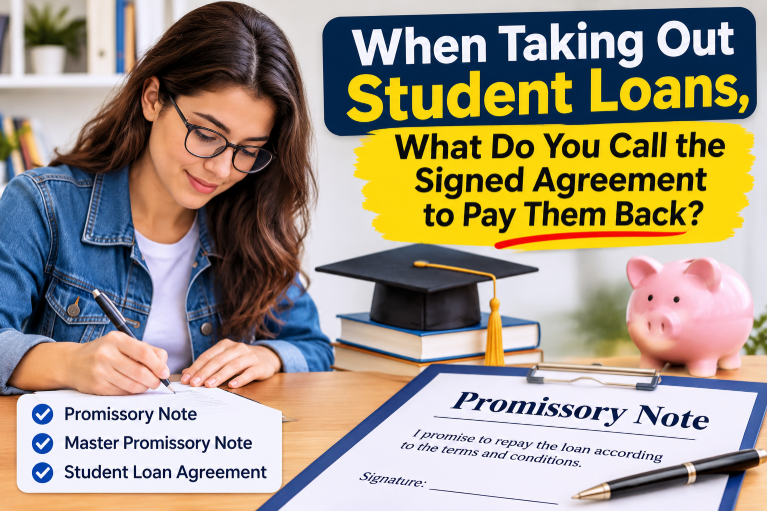
The signed agreement to repay a student loan is called a promissory note. It is a legally binding document in which a borrower promises to repay the money borrowed, usually with interest, according to the agreed terms and conditions.
For federal student loans in the United States, borrowers generally sign a document called a Master Promissory Note (MPN). This agreement explains the borrower’s obligations, repayment responsibilities, interest charges, and other important loan conditions.
Understanding this document before signing it can help students make better financial decisions, avoid misunderstandings, and prepare for repayment after completing their education.
In this guide, we will explain what a student loan promissory note is, how it works, what information it contains, the difference between a regular promissory note and a Master Promissory Note, and what students should consider before agreeing to borrow money.
1. What Is a Student Loan Promissory Note?
A promissory note is a formal financial agreement between a borrower and a lender. It records the borrower’s promise to repay the money received under specific conditions.
When students borrow money to pay for college, university, or other eligible educational expenses, the lender requires them to agree to certain repayment conditions. The promissory note provides written evidence of that agreement.
It is more than a routine application form. By signing it, the borrower accepts a financial obligation that can continue for several years after graduation.
A typical student loan promissory note explains:
- The amount of money being borrowed or the applicable loan limits.
- The interest rate and how interest is calculated.
- The repayment conditions and applicable repayment period.
- When payments are expected to begin.
- What happens if the borrower misses payments.
- The borrower’s rights and responsibilities.
- Any applicable fees or collection costs.
- Circumstances in which deferment, discharge, or cancellation may be available.
The exact information depends on the loan type and lender.
For example, a student borrowing through the US federal Direct Loan Program generally signs a Master Promissory Note. Someone borrowing from a private financial institution may sign a private student loan promissory note or another legally binding loan agreement.
The most important point is that signing the document means accepting the obligation to repay the loan according to its terms.
2. What Is a Master Promissory Note (MPN)?
A Master Promissory Note, commonly abbreviated as MPN, is a specific type of promissory note used for certain federal student loans in the United States.
It is a legal document that allows a student to agree to repay one or more eligible federal loans, including applicable interest and fees.
The US Department of Education uses the MPN for its Direct Loan Program. Rather than signing an entirely new promissory note for every eligible loan, a borrower may be able to use one MPN to cover multiple loans over a specified period.
According to Federal Student Aid, an MPN can cover multiple loans for up to 10 years, subject to the applicable requirements. Federal Student Aid+1
Why Is the MPN Important?
The MPN establishes the legal relationship between the borrower and the federal government as the lender.
It makes the borrower’s responsibilities clear before the loan funds are provided.
For example, when a student accepts a federal Direct Subsidized Loan or Direct Unsubsidized Loan, signing the required MPN is generally one of the steps that must be completed before receiving the funds.
The document also helps borrowers understand important financial conditions, including interest charges, repayment requirements, and possible consequences of failing to make payments.
Does Every Student Sign an MPN?
No. The MPN is associated with particular federal student loan programs. Private student lenders generally use their own promissory notes and loan agreements.
Students should identify their loan type before assuming that every educational loan requires the same document.
3. Difference Between a Promissory Note and a Master Promissory Note
Although these terms are closely related, they do not mean exactly the same thing.
A promissory note is the general name for a written agreement in which a borrower promises to repay borrowed money.
A Master Promissory Note is a particular type of promissory note designed to cover multiple eligible federal student loans under the applicable conditions.
Here is a comparison:
| Feature | Promissory Note | Master Promissory Note |
|---|---|---|
| Meaning | General loan repayment agreement | Specific federal student loan agreement |
| Purpose | Records a promise to repay borrowed money | Covers eligible federal student loans |
| Used by | Banks, private lenders, and other lenders | US Department of Education |
| Multiple loans | Depends on the agreement | Can cover multiple eligible loans |
| Interest details | Included according to loan terms | Explains applicable federal loan terms |
| Legal responsibility | Creates repayment obligations | Creates repayment obligations |
| Duration | Depends on the agreement | May cover loans for up to 10 years |
| Signing method | Paper or electronic | Generally completed electronically |
Both documents are important because they establish the borrower’s responsibility to repay the debt.
However, the MPN is particularly relevant to students receiving federal Direct Loans in the United States.
4. How Does the Student Loan Agreement Work?
The student loan agreement works by establishing the conditions under which a lender provides money to a borrower.
Before receiving the loan funds, the student must review the relevant documents and agree to the applicable conditions.
The process generally involves several steps.
Step 1: Apply for Financial Aid
Students seeking federal financial assistance in the United States usually begin by completing the Free Application for Federal Student Aid (FAFSA).
The FAFSA helps determine eligibility for different types of federal student assistance.
Depending on the student’s circumstances, the financial aid offer may include grants, scholarships, work-study opportunities, and federal student loans.
Students should understand that accepting a loan is different from receiving a grant. A loan generally has to be repaid, while grants usually do not require repayment unless specific conditions apply.
Step 2: Review Your Financial Aid Offer
After processing the financial aid application, the educational institution provides information about the assistance available to the student.
The student should carefully review the offer and determine how much money is actually needed.
It is not always necessary to accept the entire loan amount offered.
Borrowing less can reduce future interest costs and make repayment more manageable.
Step 3: Complete Entrance Counseling
First-time federal Direct Loan borrowers generally need to complete entrance counseling before receiving their loan funds.
Entrance counseling explains important information about borrowing, including:
- How student loans work.
- The responsibility to repay borrowed money.
- How interest affects the total balance.
- Available repayment options.
- The consequences of missing payments.
- How to manage student debt responsibly.
This process is designed to help students understand their financial obligations before accepting federal loans.
Step 4: Sign the Master Promissory Note
The next important step is signing the Master Promissory Note.
The student must read the agreement, understand its conditions, and provide the required information.
The borrower generally completes the MPN through the official Federal Student Aid website.
By signing the agreement electronically or on paper, the borrower confirms acceptance of its terms and promises to repay the applicable loans.
Step 5: Receive the Loan Funds
After completing the required steps and meeting the applicable eligibility conditions, the loan funds can be disbursed.
Federal student loan money is generally applied to eligible educational charges, such as tuition and fees. Any remaining amount may be provided to the student for other eligible educational expenses.
The student should keep records of the loan amount received and the documents associated with the borrowing process.
Federal Student Aid explains that entrance counseling and signing an MPN are required steps for borrowers receiving applicable Direct Loans. Student Aid+1
5. What Information Is Included in a Student Loan Agreement?
A student loan promissory note contains important information about the financial agreement.
Although the exact format varies between federal and private lenders, borrowers should expect the document to explain several important areas.
Loan Amount
The agreement identifies the amount of money being borrowed or the applicable borrowing limits.
Students should check that the amount they accept matches their financial needs.
Borrowing more than necessary can increase the total debt and the amount of interest paid over time.
Interest Rate
The interest rate determines how much it costs to borrow money.
Federal student loans generally have interest rates established under federal law, while private student loan rates depend on the lender and the borrower’s circumstances.
Some private loans have fixed interest rates, while others have variable rates.
A fixed rate generally stays the same, whereas a variable rate can change according to the loan agreement.
Repayment Period
The repayment period explains how long the borrower has to repay the loan.
The actual repayment schedule depends on the loan type and applicable repayment arrangement.
A longer repayment period may reduce the required monthly payment but can increase the total interest paid.
Payment Responsibilities
The agreement explains that the borrower must make payments according to the applicable terms.
It is important to understand when repayment begins, how payments are calculated, and where payments should be sent.
Late Payments and Default
The agreement also explains what may happen if the borrower does not make required payments.
Depending on the loan, missed payments can result in additional costs, collection activity, and damage to credit history.
Federal student loans and private student loans have different rules concerning delinquency and default.
Borrower Rights
The agreement may explain circumstances in which the borrower can request certain repayment benefits or protections.
For eligible federal student loans, these may include deferment, forbearance, or other available relief options.
Borrowers should review the conditions carefully because not every option is available to every student.
6. Is a Student Loan Promissory Note Legally Binding?
Yes. A properly executed student loan promissory note is a legally binding financial agreement.
When a borrower signs the document, they agree to repay the loan according to its terms.
This responsibility generally continues even if the borrower:
- Changes their college or university.
- Decides not to finish their degree.
- Changes their major.
- Does not receive the expected salary after graduation.
- Experiences difficulty finding employment.
- Is dissatisfied with their educational experience.
For federal student loans, Federal Student Aid specifically explains that borrowers must repay their loans according to the signed promissory note even if they do not complete their education or obtain a job afterward. Student Aid+1
This is why students should never sign a loan agreement without understanding the financial responsibility involved.
It is also important to remember that a promissory note does not mean a borrower has no legal protections. Certain federal programs and qualifying circumstances may provide repayment relief, discharge, or cancellation.
However, these options have specific eligibility requirements.
7. What Happens After You Sign the Student Loan Agreement?
Signing the agreement is an important part of the borrowing process, but it is not the end of the student’s financial responsibilities.
After signing, borrowers should take several steps to manage their loans properly.
Keep a Copy of the Agreement
Students should save a copy of their signed promissory note and related loan documents.
These records can help answer questions about interest rates, loan conditions, and repayment responsibilities.
Keeping digital and printed copies can also make it easier to review the agreement later.
Track Your Loan Balance
Students should monitor how much they have borrowed.
If they receive multiple loans during their education, they should keep track of each loan separately.
This helps them understand their total debt and prepare for future payments.
Understand Interest Accumulation
Interest can increase the total amount a borrower owes.
For example, interest may accumulate while a student is studying, depending on whether the loan is subsidized or unsubsidized.
Students should understand how their specific loan handles interest before borrowing.
Know Your Loan Servicer
A loan servicer handles important administrative responsibilities, including billing, payment processing, and borrower support.
For federal student loans, borrowers can identify their servicer through their Federal Student Aid account.
Prepare for Repayment
Before leaving school, students should review their repayment responsibilities and understand the available options.
Planning early can make the transition from education to repayment less stressful.
8. What Is the Difference Between Federal and Private Student Loan Agreements?
Students in the United States can obtain educational financing through federal student loan programs or private financial institutions.
Although both options involve borrowing money and agreeing to repay it, their agreements may contain different conditions.
| Comparison | Federal Student Loans | Private Student Loans |
|---|---|---|
| Lender | US Department of Education | Private bank or financial institution |
| Agreement | Usually a Master Promissory Note for Direct Loans | Private promissory note or loan agreement |
| Interest rates | Set under federal law | Determined by the private lender |
| Repayment options | Federal repayment programs | Options determined by the lender |
| Borrower protections | Federal protections may apply | Protections depend on the agreement and applicable law |
| Credit requirements | Generally not based on ordinary credit approval for most Direct Loans | Credit history and income may be considered |
| Co-signer | Not normally required for standard Direct Loans | May be required depending on eligibility |
| Loan forgiveness | Certain federal forgiveness programs may apply | Generally more limited |
Federal Student Loan Agreements
Federal student loans are provided through programs established by the US government.
For eligible Direct Loans, the borrower signs a Master Promissory Note and agrees to repay the money according to federal loan conditions.
Federal loans may offer benefits such as income-driven repayment options and qualifying forgiveness programs.
However, eligibility for these benefits depends on the loan type, applicable regulations, and individual circumstances.
Private Student Loan Agreements
Private student loans are provided by financial institutions, banks, credit unions, and specialized education lenders.
These lenders establish their own loan conditions within applicable legal requirements.
A private student loan agreement may include:
- Interest rate and repayment terms.
- Monthly payment requirements.
- Borrowing limits.
- Late payment charges.
- Co-signer responsibilities.
- Conditions for releasing a co-signer.
- Available repayment arrangements.
- Default and collection provisions.
Before signing a private student loan agreement, borrowers should compare several lenders and review the total cost of borrowing.
The Consumer Financial Protection Bureau explains that private student loans generally do not offer the same flexible repayment terms and borrower protections as federal student loans. Consumer Financial Protection Bureau+1
9. Can You Sign a Student Loan Promissory Note Online?
Yes. Many student loan agreements can be completed electronically.
For federal Direct Loans, borrowers can generally complete their Master Promissory Note through the official Federal Student Aid website.
The electronic process allows students to review the agreement, provide required information, and submit their signatures without printing and mailing paperwork.
A typical online signing process involves the following steps:
- Visit the official Federal Student Aid website.
- Sign in using your Federal Student Aid account.
- Find the Master Promissory Note section.
- Select the appropriate loan type.
- Review the agreement and its conditions.
- Provide the requested information.
- Complete the electronic signature process.
- Save or print a copy for your records.
Students should make sure they are using the official website rather than an unfamiliar third-party service.
Electronic signatures can create legally binding agreements. Therefore, borrowers should read the document just as carefully as they would read a printed contract.
10. What Should You Check Before Signing a Student Loan Agreement?
Signing a student loan agreement is a major financial decision. Students should take time to review the document before accepting the responsibility.
Here are some important things to check.
1. Confirm the Total Loan Amount
Check how much money you are borrowing.
Do not automatically accept the maximum amount offered by your college or lender.
Consider your tuition, accommodation, books, transportation, and other necessary expenses.
2. Review the Interest Rate
Understand whether the loan has a fixed or variable interest rate.
A fixed rate generally provides more predictable borrowing costs, while a variable rate may change during repayment.
3. Understand When Repayment Begins
Different student loans have different repayment arrangements.
Some federal loans offer a grace period after graduation, leaving school, or dropping below half-time enrollment.
Private lenders may have different requirements.
Always check your specific agreement.
4. Check for Additional Fees
Some loans include origination fees or other charges.
These costs can affect how much money you receive and how much you ultimately repay.
5. Understand Co-Signer Responsibilities
If a private student loan requires a co-signer, both parties should understand their obligations.
A co-signer may become responsible for repayment if the primary borrower does not make the required payments.
6. Read the Default Conditions
Find out what happens if you cannot make a scheduled payment.
Understand the possible consequences, collection procedures, and available ways to seek assistance.
7. Keep a Copy
After signing, download or print the completed agreement.
Keeping a copy helps you verify the conditions if questions arise later.
11. What Is the Difference Between a Promissory Note and Entrance Counseling?
Students sometimes confuse the promissory note with entrance counseling because both are important steps in obtaining certain federal student loans.
However, they serve different purposes.
Entrance counseling is an educational process that helps borrowers understand student loan responsibilities.
A promissory note is a legal agreement in which the borrower promises to repay the loan.
The following table explains the difference.
| Feature | Entrance Counseling | Promissory Note |
|---|---|---|
| Main purpose | Educates borrowers about loans | Establishes repayment obligations |
| Legal agreement | No, it is an educational requirement | Yes, it is a binding loan agreement |
| Information | Borrowing, interest, repayment, and debt management | Loan terms, borrower promises, and responsibilities |
| Signing | Completion is acknowledged | Borrower signs the agreement |
| Importance | Helps students understand borrowing | Records the promise to repay |
Both steps are important for applicable first-time federal Direct Loan borrowers.
Completing counseling does not replace the requirement to sign the promissory note.
12. What Happens If You Cannot Repay Your Student Loan?
Financial difficulties can happen after graduation. Some borrowers may struggle to find employment, experience reduced income, or face unexpected expenses.
However, difficulty making payments does not automatically remove the legal obligation established by the promissory note.
The appropriate response depends on the type of loan.
Contact Your Loan Servicer
If you are struggling financially, contact your loan servicer as soon as possible.
Explain your situation and ask about available repayment assistance.
Avoid ignoring payment notices because unpaid loans can create additional financial problems.
Explore Available Federal Repayment Options
Borrowers with eligible federal student loans may have access to repayment arrangements designed around their circumstances.
Depending on applicable rules, these may include income-driven repayment plans or other available options.
Eligibility and payment calculations can vary.
Consider Deferment or Forbearance
Deferment and forbearance may allow eligible borrowers to temporarily postpone or reduce payments.
However, interest may continue to accumulate, depending on the loan type and the specific relief arrangement.
Borrowers should understand the financial impact before requesting either option.
Understand Loan Default
Default occurs when a borrower fails to meet the repayment requirements for a sufficiently long period.
For many federal Direct Loans, default generally occurs after 270 days of missed scheduled payments.
Default can have serious consequences, including collection activity and restrictions on access to certain federal student aid benefits.
Students should seek assistance before reaching this stage. Federal Student Aid+1
13. Does Signing a Promissory Note Mean You Must Repay the Loan Even If You Drop Out?
Generally, yes.
A student loan is borrowed money, not a payment that automatically becomes free simply because the student stops attending college.
When a borrower signs the promissory note, they agree to repay the loan according to its conditions.
This means that leaving school, changing educational institutions, or deciding not to complete a degree does not automatically cancel the repayment obligation.
However, certain legal exceptions and discharge provisions may apply in specific circumstances.
For example, some borrowers may qualify for relief involving school closure, qualifying disability, or other circumstances recognized under applicable federal rules.
Students should contact their loan servicer or financial aid office to understand their options.
14. Where Can You Find Your Signed Student Loan Agreement?
If you have already borrowed money and cannot remember signing a promissory note, there are ways to locate your loan documents.
Federal Student Loans
Borrowers can visit the official Federal Student Aid website and sign in to their accounts.
The website provides access to federal student loan information and relevant account services.
Students can review their loan history and find information about their loan servicers.
Private Student Loans
For private loans, contact the financial institution that provided the money.
The lender or loan servicer may be able to provide a copy of the original promissory note.
You can also review your original loan paperwork or contact your school’s financial aid office for assistance.
The Consumer Financial Protection Bureau recommends reviewing original loan paperwork, including a promissory note or disbursement notice, when identifying a private student loan servicer. Consumer Financial Protection Bureau+1
Why Should You Keep Your Agreement?
Your signed agreement can help you answer important questions, such as:
- How much money did you originally borrow?
- What interest rate applies?
- When are payments due?
- What repayment conditions did you accept?
- Who is responsible for repayment?
- What happens if you miss payments?
Keeping these documents organized makes it easier to manage your educational debt.
15. Common Mistakes Students Make When Signing Loan Agreements
Many students focus on receiving financial assistance without paying enough attention to the repayment conditions.
This can lead to confusion and unnecessary financial pressure later.
Here are some common mistakes to avoid.
Accepting more money than necessary: Borrowing the maximum available amount may seem convenient, but it increases future repayment responsibilities.
Ignoring interest charges: Students sometimes assume that their loan balance will remain unchanged while they study. This is not always true, particularly with unsubsidized loans and private loans.
Not reading the agreement: Signing without understanding the terms can lead to unexpected financial obligations.
Confusing loans with grants: A grant generally does not require repayment, while a student loan normally does.
Forgetting about co-signers: Private student loan co-signers may share legal responsibility for repayment.
Ignoring communication from the servicer: Important repayment notices and account information should never be overlooked.
Failing to plan for repayment: Students should consider their expected income and future expenses before borrowing.
Avoiding these mistakes can help students make more informed financial decisions and manage their educational debt responsibly.
16. Important Terms Related to Student Loan Agreements
Understanding common student loan terminology can make the borrowing process easier.
Here are some terms students should know before signing their agreements.
| Term | Meaning |
|---|---|
| Promissory Note | A legally binding promise to repay borrowed money |
| Master Promissory Note (MPN) | A federal student loan agreement that can cover multiple eligible loans |
| Principal | The original amount borrowed, excluding interest |
| Interest | The cost of borrowing money |
| Loan Servicer | An organization responsible for managing loan payments and borrower accounts |
| Deferment | A temporary postponement of eligible loan payments |
| Forbearance | A temporary period of reduced or postponed payments under applicable conditions |
| Default | Failure to meet loan repayment requirements |
| Grace Period | A specified period before certain borrowers must begin repayment |
| Co-Signer | A person who agrees to share legal responsibility for a loan |
| Loan Disbursement | The release of approved loan funds |
| Repayment Plan | The arrangement that determines how a borrower repays a loan |
Learning these terms can help students understand their promissory notes and communicate more effectively with lenders and loan servicers.
Frequently Asked Questions (FAQs)
1. When taking out student loans, what do you call the signed agreement to pay them back?
The signed agreement is called a promissory note. It is a legally binding document in which the borrower promises to repay the borrowed money, including applicable interest and fees, according to the agreed conditions.
2. What is the official name of the federal student loan agreement?
The official name is the Master Promissory Note (MPN). It is used for eligible federal Direct Loans in the United States and explains the borrower’s repayment obligations.
3. Is a Master Promissory Note the same as a promissory note?
They are closely related but not identical. A promissory note is a general loan repayment agreement, while a Master Promissory Note is a specific agreement that can cover multiple eligible federal student loans.
4. Do private student loans require a promissory note?
Private student loans generally require borrowers to sign a promissory note or another legally binding loan agreement. The document explains the interest rate, repayment conditions, fees, and other responsibilities established by the lender.
5. Is a student loan promissory note legally binding?
Yes. Once properly signed, a promissory note establishes a legal obligation to repay the loan according to its terms. Borrowers should read and understand the agreement before signing.
6. When do students sign the Master Promissory Note?
Students generally sign the MPN before receiving applicable federal Direct Loan funds. It is usually completed after accepting the loan and completing the required financial aid steps.
7. Can I sign my student loan agreement electronically?
Yes. Federal student loan borrowers can generally complete their Master Promissory Note electronically through the official Federal Student Aid website. Private lenders may also offer electronic signing.
8. Does a promissory note include the interest rate?
Yes, the agreement explains the applicable interest conditions. Borrowers should review the rate, how interest is calculated, and whether additional fees apply.
9. Do I have to repay my student loan if I do not graduate?
Generally, yes. Leaving college or failing to complete a degree does not automatically cancel the obligation to repay borrowed money. Certain discharge or relief options may apply in qualifying circumstances.
10. What happens if I lose my signed promissory note?
You can request another copy. Federal borrowers can check their Federal Student Aid accounts, while private borrowers can contact their lenders or loan servicers.
11. Can parents sign a student loan promissory note?
Yes, depending on the loan. For example, a parent borrowing through a federal Direct PLUS Loan signs their own Master Promissory Note and becomes responsible for repaying that loan.
12. How long is a Master Promissory Note valid?
A federal MPN can generally cover eligible loans for up to 10 years, subject to program requirements. Certain circumstances may require a borrower to complete a new MPN.
13. What is the difference between a loan application and a promissory note?
A loan application provides information used to request or evaluate financing. A promissory note is the legal document establishing the borrower’s promise to repay the money under specified conditions.
14. Can I cancel a student loan after signing the agreement?
Depending on the loan type and timing, borrowers may be able to cancel all or part of a loan before funds are disbursed or within applicable cancellation periods. Contact your school’s financial aid office or lender immediately to understand the available options.
15. Where can I sign a federal student loan promissory note?
Eligible federal student loan borrowers can access the official signing process through StudentAid.gov. They should sign in using their Federal Student Aid account and select the appropriate Master Promissory Note.
Conclusion
When taking out student loans, the signed agreement to pay them back is called a promissory note. For eligible federal Direct Loans in the United States, this document is generally known as the Master Promissory Note (MPN).
It is an important legal agreement that explains how much money the borrower may receive, applicable interest conditions, repayment responsibilities, and other loan requirements.
Before signing, students should carefully review the agreement, understand the financial obligations, and consider how borrowing will affect their future finances.
Whether you choose a federal student loan or private educational financing, understanding the promissory note is an essential part of responsible borrowing.
Taking time to understand the document before signing can help prevent confusion and prepare you for managing student debt after completing your education.
Authoritative Resources for Further Reading
For readers who want to learn more about student loan agreements and repayment responsibilities, these official resources are useful:
- Federal Student Aid – Financial Aid Dictionary – Explains important financial aid terms, including the Master Promissory Note.
- Federal Student Aid – Types of Student Loans – Provides information about federal student loans and borrowing requirements.
- Official Federal Master Promissory Note – Provides an example of a federal student loan agreement.
- Consumer Financial Protection Bureau – Private Student Loans – Explains private student loan financing.
- Consumer Financial Protection Bureau – Finding Student Loan Information – Explains how borrowers can locate their loan information.

